"Truth of any kind is food for the soul."

The Rev. Jesse Caswell, 1841

Friday, February 6, 2015

Surviving Titanic: the Caldwell Family's Story

The Titanic
The study of Thai church history takes its practitioners into sometimes unexpected places. "Surfing the Web" for entries for my Bibliography of materials related to Christianity in Thailand, I recently came across a citation that was very much unexpected.  It is a book by Dr. Julie Hedgepeth Williams entitled, A Rare Titanic Family: The Caldwells Story of Survival (NewSouth Books, 2012), which tells the story of Albert and Sylvia Caldwell and their infant daughter.  The Caldwells were appointed by the Board of Foreign Missions of the Presbyterian Church U.S.A. to serve as missionaries in Bangkok.  They arrived in 1909 where they took up their duties at the Bangkok Christian High School (BCC today).  Sylvia, however, soon became ill, and they resigned from the Siam Mission at the end of 1911.  The Caldwells and their infant daughter travelled home via Europe and booked passage on the Titanic for their Atlantic crossing.  And the rest, as they say, is history.

The publisher has made available a podcast of an interview done with Albert in the early 1970s.  It is 22 minutes long and provides fascinating insights into the sinking of the Titanic.

Sunday, February 1, 2015

"A Missionary in Siam" - A Digital Exhibition

The Five Colleges of Ohio Digital Exhibitions website is currently hosting an exhibit by Genevieve Senechal of Oberlin College entitled, "A Missionary in Siam."  The subject of the exhibit is the life and word of the Rev. Dr. Dan Beach Bradley, the premier Protestant missionary in Siam in the nineteenth century.  The exhibit includes photographs, including the unique family portrait on the life (taken in 1864 and including Rev. Daniel McGilvary), documents, historical sketches, and historical notes not only on Bradley but also on the nation of Siam during his lifetime.
The exhibit provides a good introduction to Bradley, to Protestant missions in Siam in his time, and to Siam generally in that era.  It is worth spending a little time.

Wednesday, December 31, 2014

Difficulties in Evangelism in Thailand—A Recent Take

Writing in the Huffington Post, Jim Stiller, a Global Ambassador for the World Evangelism Crusade, published an article that I have just come across entitled, "The Difficulty of Evangelizing in Thailand," which is not particularly insightful in one sense but does provide a general orientation to the reasons usually given for the lack of evangelistic numerical success in Thailand. It is particularly interesting to note the sense of optimism about future success conveyed to Stiller by some in Thailand. That, too, historically has a common theme in many commentaries on the evangelization of the Thai people.

Friday, September 12, 2014

Dr. Carle Clark Zimmerman

One way that I build on the entries in "An English-Language Bibliography of Materials Related to Christianity in Thailand," is by selecting authors of current entries and searching online for additional citations by that author.  Sometimes all I get is nothing, but sometimes the Web contains fascinating new sources.  Such is the case with Dr. Carle Clark Zimmerman (1897-1983), a Harvard sociologist who spent time in Siam back in the 1930s working with the American Presbyterian Mission.  He seems to have worked primarily with Bertha Blount McFarland, a former member of the mission who married George Bradley McFarland.  She remained very active in Christian work in Bangkok after her marriage.  Zimmerman conducted sociological studies for the mission, and the most important result of his work was the book, Siam: Rural Economic Survey, 1930-31.  That book does not appear in the bibliography because it is about Siam generally and not about Christianity in Siam at all.

Zimmerman, however, did produce some unpublished work relevant to Thai Christianity that he co-authored with Bertha McFarland.  It turns out that the University Archives & Special Collections division of the University of Saskatchewan Library contains a manuscript collection of Zimmerman materials (finding aid) that includes a couple of interesting items regarding his work in Siam: the first is a diary that Zimmerman kept of a trip to Chiang Mai in December 1930-January 1931; and the second is a 271 page unpublished manuscript entitled, "Christian Missions in Siam: A Study in Oriental Culture."  I haven't included the diary in the bibliography because I'm not sure of its contents, but the unpublished manuscript is obviously relevant and an unexpected find.

Knowing the quality of Zimmerman's work, it is very likely that his study of the missions in Siam is a very helpful document.  It could be valuable in a couple of ways.  First, the missionary sources and other English-language sources for the study of Thai church history are relatively meager for the 1930s; second, Zimmerman brought an academic expertise to his research, which is rare for that era.

Friday, August 15, 2014

Thoughts On Conversion, Ancient and Historical

It was just ten years ago that I did a small HeRB piece (here) on the insignificance of Thai church history in the larger scheme of things.  I also noted that, "What is endlessly fascinating to me, however, is that from the 'inside' the field seems huge. Even Protestant history in Thailand has more to it than any one or two scholars can possibly encompass; and, of course, the issues involved in the study of Thai church history are as broad in many ways as the global church itself."

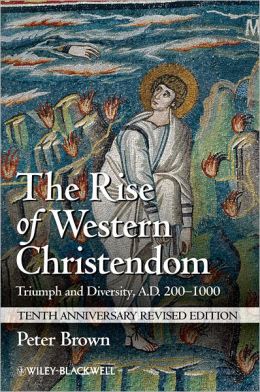
Peter Brown's The Rise of Western Christendom (10th Anniversary Revised Edition, 2013) offers a number of fascinating cases making that last point concerning the breadth of the history of Christianities in Thailand.  According to Brown, one of the most fascinating and significant similarities is the question of the relationship of converts to their pre-Christian past and how that relationship is understood by those in positions of ecclesiastical power.  In his discussion of the 6th and 7th centuries, Brown observes that in the Eastern Roman Empire church leaders tended to dismiss "paganism" as something that had been defeated and thus was inconsequential.  They treated remaining traces of the pagan past with a degree of tolerance.

Such was not the case in the disintegrating Empire in the west.  There traditional religions remained more influential and ecclesiastical authorities tended to think that the pagan past was powerful and dangerous.  That is, "each believer had to continue, even after conversion and baptism, to battle with the tenacity of evil customs with himself or herself."  Thus, "paganism was now seen to lie close to the heart of all baptized Christians.  It was always ready to re-emerge in the form of 'pagan survivals.'" (p. 150)

In early Thai church history, the missionaries including esp. the Presbyterians clearly shared the western view rather than the eastern.  It would be fascinating, in fact, to see if a direct line could be traced through the centuries linking 6th century western European views on paganism to 19th and early 20th century American Presbyterian missionary views of Buddhism.  I suspect there is a link, but even if there is not a direct one the two eras shared a general concern over the influence of the past on converts.  Conversion was never complete.  For the Presbyterian missionaries, this was not so much a matter of moral behavior (although at times they did worry about convert morals as well) as it was a question of beliefs and religious practices.  Converts, for example, had a troubling habit of continuing to rely on traditional medical practices when missionary doctors weren't readily available—and sometimes even when they were.  If Brown is correct, the eastern churches would have tended to dismiss such a reliance as nothing more than an inconsequential leftover from the pagan past—or, in this case, the traditional religious past of the Thai convert.  The missionaries, however, saw convert reliance on traditional medicine as a clear indication that they had not fully converted to their new religion.  They were still in danger of slipping back into their "heathen" past.

In other words, the missionaries could not entirely trust converts because they showed clear evidence of not having made a full change from the past.  Traditional village Buddhism and animism remained potent in them.  My own study of Thai church history in northern Thailand early on led me to the conclusion that this lack of trust between the missionaries and converts had devastating consequences for the churches that emerged from missionary efforts.  At the close of, Khrischak Muang Nua (1984),  I wrote, "The summary of everything that I read [in Presbyterian missionary records] is this: the Laos Mission [in northern Siam] persisted in demeaning, decapitating, dismembering, and ignoring the church it was supposed to train up, to raise up."  A little harsh, perhaps, but that was 30 years ago!  The larger point that mistrust was a fundamental element in missionary-convert relations remains true.

What is fascinating is to find in Brown a couple of insights.  First, this kind of mistrust of conversion and converts goes back a long, long way in Christian history.  Second, "back then" not every corner of the larger church shared that lack of trust.  One point that is different is that in the 6th century those who were in positions of power shared the culture and ethnicity of those they mistrusted.  Ultimately, every body was in the same boat.  Such was not the case in earlier Thai church history.  In their own thinking, the missionaries did not share in the dangers of conversion because they weren't converts.  They came, in their own thinking, from a fully Christian culture and society.  That difference has injected a major complexity into Thai church life that continues to have an impact on it down to the present, esp. since most of the missions that entered Thailand after World War II exhibited much the same basic orientation to missionary-convert relations that marked earlier Presbyterian work.

Thursday, July 31, 2014

Layers

In the "Preface to the Tenth Anniversary Revised Edition" of his book, the Rise of Western Christendom (Wiley-Blackwell, 2013), historian Peter Brown makes the point that the emergence of Western European Christendom out of the Roman Empire was marked as much by continuities as discontinuity.  He notes that traditionally it is the kings, warriors, bishops, and missionaries who have been the focus of historical interest.  They have dominated the story of the emergence of Medieval Europe.  Many historians have told the tale, furthermore, as if it was a steep decline into social and cultural darkness marked by catastrophe.  Brown makes it clear that it wasn't really like that.  The transformation of Europe in the centuries from AD 200 to 1000 was a slow long process.  Common people making uncountable numbers of small daily decisions played as important a part as did kings and bishops, warriors and missionaries.  Significant elements of the secular Roman past persisted quietly into an age that we usually considered to be entirely dominated by the church.  Brown doesn't put it this way, but it is as if there were layers of change, some obvious and on the surface, others more subterranean and unseen even by those living through the time.

Brown offers a potentially valuable way of re-imagining the history of the Christian faith in Thailand.  Given the fact that almost all of our source material for the study of Christianity in Thailand comes from missionaries until well into the twentieth century, it is only natural to focus on them as the core of the story.  Brown challenges historians of Christianity in Thailand, however, to find creative ways to refocus our attention on the people in the pews—to see, for example, how family culture and traditions influenced the reception and practice of the Christian faith by the early generations of converts.  In what ways, then, did the Christian faith that emerged in northern Thailand differ from that in Bangkok and how did southern Thai Christianity differ from them both?

Changing focus in this way is not easy when our records are in English and written by individuals who were mostly distant from the day to day practices esp. in the rural churches.  They, furthermore, intentionally sought to instill as western a form of the faith in the converts as possible.  Still, it is part of the historian's task to read between the lines, ferreting out hidden implications in the record that we have.  And, compared with the sources that historians of early Medieval Europe have to work with, we can hardly complain.  Our is by most any measure a resources-rich field of historical study.  The layers of change are there, if only we have the wit to see them and interpret them in a way faithful to the past that actually happened.

Saturday, July 19, 2014

Dissertations & Theses - Two Lists

Since Paul Fuller, a Presbyterian missionary, wrote a B.Th. thesis on Christian approaches to Buddhism in 1929, there has been well over 150 dissertations and theses written on subjects related to Christianity in Thailand.  The next thesis after Fuller wasn't written until 13 years later, 1942—by Helen McClure, another Presbyterian missionary.  Hers was the first master's thesis.  In 1961, Ach. Pisnu Akkapin was the first Thai to write a thesis, and the first doctoral dissertation was completed just six years later by another Presbyterian missionary, Jay Johnson.  By the 1990s, this trickle of academic treatments of Christianity in Thailand became something of a flood, which has continued down to the near present.  All of this and more is revealed in two lists of dissertations and theses related to Christianity in Thailand, which I have recently uploaded as pdfs to herbswanson.com.  One (here) is an alphabetical listings, and the other (here) lists the dissertations and theses by year.  The source for both lists is, of course, my ongoing "An English-Language Bibliography of Materials Related to Christianity in Thailand."

While the alphabetical listing is probably the more useful on for researchers, the chronological list is the more interesting because it gives a sense of the ebb and flow of various subjects investigated by academic researchers.  The great majority of those researchers are missionaries and Thai Christians investigating a variety of subjects important to them and to the church in Thailand including numerous works on church growth and evangelism.  Far fewer are the work of secular scholars, the first being Donald Lord's very useful 1964 Ph.D. biography of Dan Beach Bradley, which Lord later published as  Mo Bradley and Thailand (1969).

The most recent items on the list were completed in 2011.  I can only guess that at least some dissertations and theses written in the last two-plus years haven't been cataloged into the online data bases, and I haven't yet come across any of those that have.  Recent rates of production suggest that there should have been about a half dozen or so new works since 2011.